Fix the Floor

Press

Material for press use. Bios, key facts and cover art are here to be quoted, reproduced and reused without asking.

Bios

50 words(52 words)

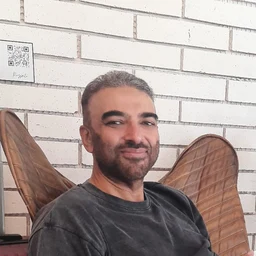
Aamir Saeed Malik is Professor at Brno University of Technology, where he heads the Cognitive & Neural Engineering Research Group. He came to health the long way round: a PhD in mechatronics, then years of brain-imaging research. He has written five scientific books; Fix the Floor is his first for general readers.

200 words(183 words)

Aamir Saeed Malik is Professor at Brno University of Technology in the Czech Republic, where he heads the Cognitive & Neural Engineering Research Group.

He came to health the long way round. His doctorate, from the Gwangju Institute of Science and Technology in South Korea, is in mechatronics — the engineering of systems that sense, decide and act. He spent the years since using brain imaging to catch stress, anxiety and depression at their earliest signs, work that has taken him through South Korea, Malaysia, Australia and now the Czech Republic. In Malaysia he headed CISIR, the national center for neuroimaging research.

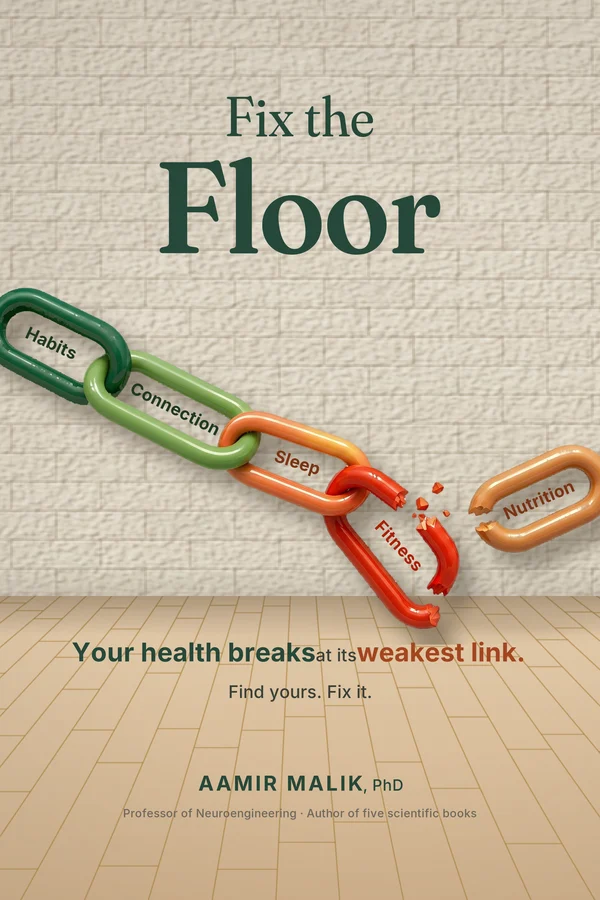
That engineer's habit — asking not what has broken but where a system fails first — is what produced this book. Health, he argues, is not a collection of separate problems but one system standing on five pillars, and like any chain it fails at its weakest link.

His research has earned more than 13,000 citations and seven granted patents. He has written five scientific books; Fix the Floor is his first for the people that science was meant to help.
Key facts

TitleFix the Floor
SubtitleYour health breaks at its weakest link. Find yours. Fix it.
AuthorAamir Saeed Malik, PhD
PublicationOctober 2026
PublisherPublished independently by Aamir Saeed Malik
Paperback ISBN978-1-7648715-0-1
Ebook ISBN978-1-7648715-1-8
Trim6 × 9 in
Extent410 pages
BISACHEA010000 · HEALTH & FITNESS / Healthy LivingSEL016000 · SELF-HELP / Personal Growth / HappinessHEA049000 · HEALTH & FITNESS / Aging & Longevity
Formats at launchEbook and Color Paperback will be available on Amazon from 3rd October 2026

What is in the book

FactWhere it comes from
Five pillars — nutrition, fitness, sleep, personal habits, social connectionThe book's own structure
A home self-assessment across eight domains, in about fifty minutes, needing no laboratory and no wearableChapter 3
Twelve chapters, four partsThe book's contents
52 figures and 28 tablesCounted in the manuscript
A companion research map of 138 entries — 25 conditions, 46 nutrients, 13 body systems, 54 non-diet leversDerived from The Healthspan Map v10
1,254 evidence links, drawn from 558 sources, each one named and traceableDerived from the same workbook

Questions we’re often asked

  1. 1. You're not a doctor. Why should anyone take health advice from you?

    I've spent three decades measuring health in a laboratory — brain imaging to catch stress, anxiety and depression at their earliest signs. That's thirteen thousand citations and seven patents, all of it written for other scientists. What I'm not is a doctor, and this book doesn't practice medicine: it doesn't diagnose, prescribe or replace anyone's clinician. What it practices is measurement — showing you where your own system is weakest, so you and your doctor are looking at the same thing.

  2. 2. People try one fix at a time — the diet, the steps, the supplement. Why does that keep failing them?

    Because every one of those fixes is partly right, and none of them is the whole. If your sleep is what's dragging you down, the best diet in the world won't move you. Strengthening what's already strong changes nothing. You have to find the weakest link first.

  3. 3. You say health breaks at its weakest link. What does that mean for someone already doing a lot right?

    It means the effort may be going to the wrong place. Someone who eats well, walks daily and still feels flat is usually strong in four pillars and weak in one — and the one they're not thinking about is the one holding them back. The book's job is to find which.

  4. 4. The book asks people to score themselves. Isn't that risky — telling someone a number about their own health?

    It would be if the number were a verdict. It isn't — it's a mirror. The score tells you where to look, not what's wrong with you, and the book says so on the page. It works alongside a doctor and never in place of one.

Assets

Contact

hello@fixthefloor.life